

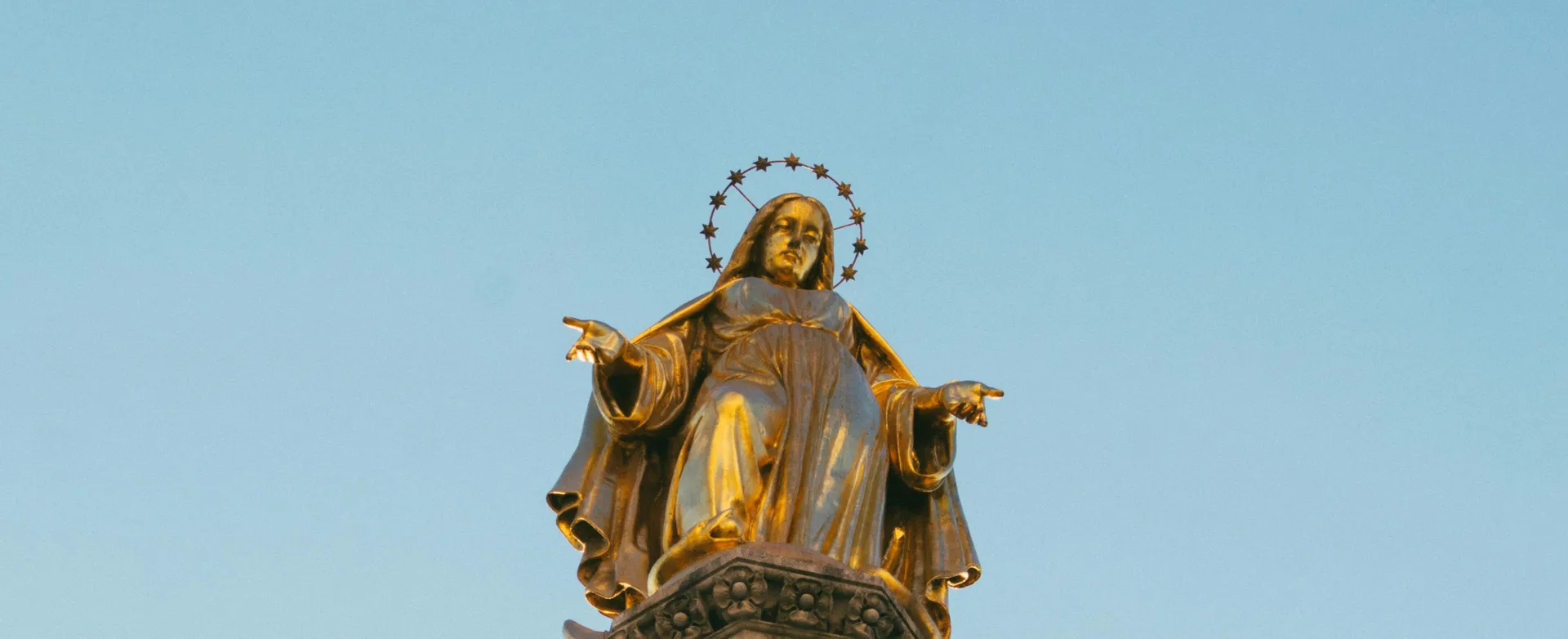
Making Sense of the Talk About Mary's Role
Joseph Loftus CM|
Director
You may have seen headlines about a recent Vatican letter discussing formal titles for Mary like "Co-Redemptrix," "Mediatrix," and "Advocate."
This is dense theological language, and it's fair to wonder what it means for us today. If you're finding it hard to grasp, here is a breakdown in plainer terms
1. If Jesus is our one Saviour, how can Mary be called "Co-Redemptrix"?
This is the most important question. You are correct: Christian faith teaches that Jesus Christ is the sole Redeemer. The term 'Co-Redemptrix' can be confusing because the prefix "Co-" in English often implies an equal partner, like a co-pilot. In this context, however, it means 'Co-operator with.' Nothing and no one else could do what He did, but Mary uniquely cooperated with His work.
Think of it like a major construction project, such as building a new hospital. Jesus is the project lead, the architect, and the one who does the essential work. Mary’s role was like that of the indispensable site manager who was there from the first planning meeting. She got the project started with her "yes," and she stayed on-site through the entire build, even when it was toughest. She didn't lay the foundation, but her cooperation was crucial from start to finish. She was fully involved, but she wasn't the lead architect.
2. What does "Mediatrix of All Graces" actually mean?
It’s a complex term for a simple idea: Mary is the first human channel of God's grace. Think of it this way:
- The Trinity is the source of all Grace.
- The Father is the Source (like the sun).
- The Son, Jesus, is the Light itself (the sun's rays).
- The Holy Spirit is the Power that brings the light into our hearts (the warmth we feel).
- Mary's role is like a perfectly clear stained-glass window. The window doesn't create the light, but it was uniquely made to receive it and let it pass through beautifully into the world. She was the human channel God prepared to bring the Light of the World—Jesus—to us, and she now helps that light reach us through her perfect prayers.
In short: All grace comes from the Trinity. Mary is the first and foremost human channel He chose to bring Jesus, the source of all grace, to the world. She is a unique channel, but not the only one, as God's grace also flows through the Sacraments, Scripture, and the prayers of all the saints.
3. But the Holy Spirit is called our Advocate. Why use the same title for Mary?
This is a very sharp point. The Holy Spirit is indeed the primary Advocate, the divine helper.
When this title is used for Mary, it’s in a different sense. Think of it like a crucial character reference. If you were in a serious situation, you'd want someone who knows you and the judge well to speak on your behalf. That’s Mary. She’s the one in heaven who knows us and knows her Son intimately, and she constantly brings our needs to him. It’s a role of support and intercession, not of divine power. So, while the Holy Spirit is our divine Advocate, we can see Mary as our heavenly advocate.
4. Is the Church about to make this a new defined dogma?
This is the heart of the current debate. The Church undeniably teaches that Mary played a unique and vital role in salvation, and the concepts behind these titles have been discussed for centuries.
However, the Church has been hesitant to formally define them. Why? Because words matter. There is a concern that these particular terms could be misunderstood to place Mary on a level with Jesus, which is not the faith. So, while the Church celebrates Mary’s role, it often uses other, clearer titles like "Mother of God" and "Model of the Church." The Pope’s caution reflects a pastoral desire to keep the focus clear and avoid theological confusion.
5. So, what's the key takeaway for my faith?
The essential thing to remember is this: Everything about Mary directs our attention to Jesus.
Her entire purpose was to bring Christ into the world and to instruct us, as she did at Cana, to "Do whatever he tells you." Honouring her doesn't subtract from Jesus; it helps us appreciate the human cooperation God invites. She is the ultimate example of what it means to fully consent to God’s plan. She shows us the way to her Son.