

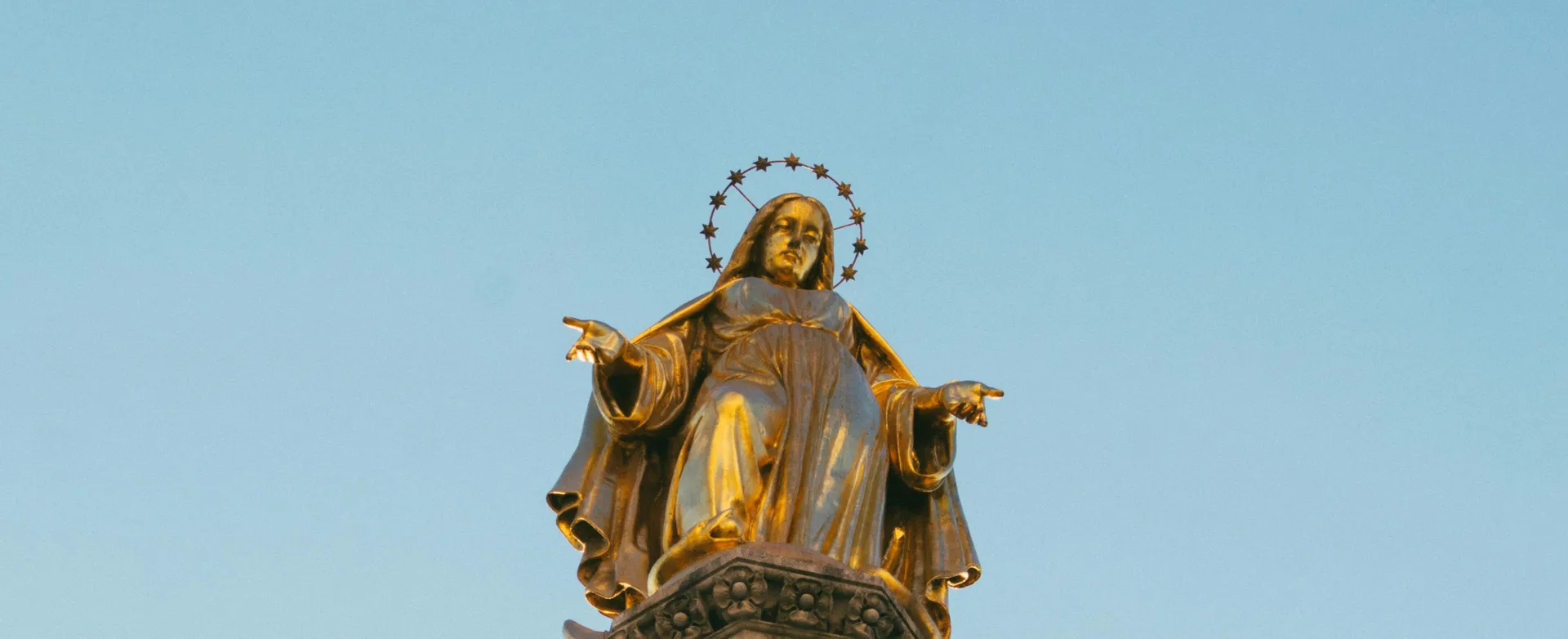
Beyond the Gaslight: Reclaiming the Miraculous Medal for a Modern Age
Joseph Loftus CM|
Director
Beyond the Gaslight: Reclaiming the Miraculous Medal for a Modern Age
It would be easy to dismiss the Miraculous Medal as a relic of a bygone era, a piece of spiritual nostalgia as obsolete as the gaslit world that gave it birth. To many, this devotion appears charming but ultimately irrelevant, its sentimental art and florid prayers seemingly designed for a society in petticoats, not for our age of stark digital communication. On an aesthetic level, I share these reservations. The common images can feel cloying, reminiscent of paintings that obscure a saint's true steel with saccharine sweetness, and the language of "virginal purity" can feel like a relic from a world of horse-drawn trams, conjuring a repressed sexuality from which we assume we've been liberated.
So, why not let it go? Why not gently lay it aside and seek new ways of honouring the Mother of God more suited to our time? Fashions change, even if faith does not. Must we hold onto a 19th-century devotion that seems so out of touch with the complexities of the 21st century?
A Nagging Doubt: The Witness of the Saints
Yet, a nagging doubt persists. This doubt is crystallised by the testimony of two formidable advocates: Maximilian Kolbe and Frank Duff. Kolbe, a media-savvy evangelist, ultimately offered his life in Auschwitz. Frank Duff founded the robust, global Legion of Mary. Their faith was active, intellectual, and heroic. If this devotion played a part in forming such a faith, then to dismiss it as a mere sentimental fad is a lazy and arrogant presumption.
Then there is Catherine Labouré herself. She became a saint not through visions alone, but through what she did with the grace she received. She stubbornly insisted on the truth of the medal’s design and then dedicated forty years to obscure, practical service to the poor, guarding her secret identity. She was no wilting flower from a gaslit parlour; her life was one of fortitude and profound integrity.
A Personal Synthesis: The Medal as a Sacramental in a Postmodern Age
My own journey has moved beyond intellectual argument to a simple, practical integration. It began with a recurring, quiet failure. A friend would confide the crushing weight of a diagnosis, a family would be fractured by grief, or a colleague would be adrift in professional despair. In the face of their pain, the promise "I will pray for you" felt like the only authentic, immediate response—a verbal embrace, a pledge of solidarity. I meant it with my whole heart in that moment. Yet, in the busyness of the hours and days that followed, that sincere promise too often remained just that: a fleeting mental note, a ghost of good intention that faded against the clamour of daily life. I felt a quiet shame, as if I had offered a lifeline only to immediately drop my end of the rope.
To counter this, I developed a small but transformative practice. Now, when the memory of that person and their struggle surfaces—whether while waiting for a train, between tasks at my desk, or in a quiet moment at home—I no longer let it drift by. I consciously reach for the medal in my pocket. The physical act of feeling its cool, stamped surface, of tracing the familiar rays of grace with my thumb, becomes a ritual of recollection. Holding it, I deliberately offer a prayer for that specific person and their situation. The action takes only a moment, but it is a moment of profound re-orientation. It crucially elevates the prayer from a passive, forgotten sentiment to a focused, intentional act of intercession. The medal is no longer just an object; it is the trigger for a kept promise. The Unresolved Tension: Language, Image, and Reinterpretation
This personal practice does not entirely resolve the tensions. The language and cloying images remain a hurdle. I have not fully reconciled myself to the phrasing, but I have come to a provisional understanding. I now interpret “purity of mind and body” as purity of intention—a single-minded integrity in living out my faith. This makes it a universal, demanding challenge, far removed from a Victorian ideal of womanly virtue.
The images, too, need renewal. We are in desperate need of artists who can find a visual language for this devotion that is faithful yet resonates with our time.
A Faith for All Seasons
In the end, this journey is a microcosm of living a traditioned faith in a modern world. We are often presented with two seemingly opposing responses: the first is to discard what seems outdated, to relegate devotions like the Miraculous Medal to the museum of gaslight and petticoats. The second, a reactive impulse, is to retreat entirely into a sentimental piety of a more receptive age, embracing its aesthetic and linguistic trappings as a bulwark against modern complexity. The initial impulse to discard is understandable, while the retreat into nostalgia feels safe.
But a mature faith asks us to do the harder work of discernment, to dig deeper and distinguish the period trappings from the timeless grace. Perhaps it is precisely in our postmodern moment, with its yearning for the tangible, that this sacramental finds a new and urgent voice, one that speaks not of escape but of grounded, intentional engagement.
True promotion of the Miraculous Medal, however, rejects both of these dead ends. It is not an exercise in preserving a gaslight worldview, nor is it the distribution of quaint souvenirs from a more pious past. Authentic promotion is about pointing to a living, accessible spiritual current—the very current that empowered a martyr, a revolutionary layman, and a stubbornly humble nun. It is the work of proposing a tool, one that is startlingly relevant for our age, designed to transform the lazy spiritual inclinations of the human heart into deliberate, tangible acts of prayer.
The gaslight era is over. The horse-drawn tram belongs in a museum. But the human heart's need for a tangible bridge to the divine—for an anchor in the abstract and a catalyst for purpose—is eternal.
O Mary conceived without sin, pray for us who have recourse to thee.